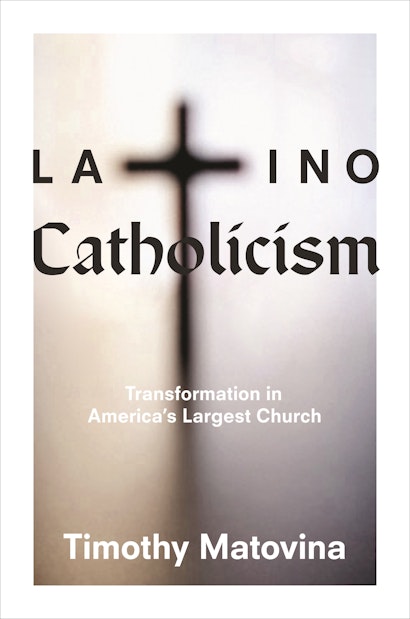
Most histories of Catholicism in the United States focus on the experience of Euro-American Catholics, whose views on social issues have dominated public debates. Latino Catholicism provides a comprehensive overview of the Latino Catholic experience in America from the sixteenth century to today, and offers the most in-depth examination to date of the important ways the U.S. Catholic Church, its evolving Latino majority, and American culture are mutually transforming one another.
In Latino Catholicism, Timothy Matovina highlights the vital contributions of Latinos to American religious and social life, demonstrating in particular how their engagement with the U.S. cultural milieu is the most significant factor behind their ecclesial and societal impact.
Awards and Recognition
- Timothy Matovina, Winner of the 2013 Paul J. Foik, C.S.C. Award, Texas Catholic Historical Society
- First Place for the Book Award in History, 2013 Catholic Press Association
- Winner of the 2012 Best Book Award, College Theology Society
- One of Choice's Outstanding Academic Titles for 2012
"Matovina gives a detailed examination of the different pastoral approaches that have been adopted to deal with the influx of Latino immigrants, with some advocating the need to assimilate quickly to American ways and others preferring to focus on preserving the religious and cultural heritage that the immigrants have brought with them. . . . Matovina's book should be mandatory reading for all bishops, clergy, and lay leaders, and for anyone else who wants to understand the future of American Catholicism."—Michael Sean Winters, New Republic
"Timothy Matovina, director of the Cushwa Center for the Study of American Catholicism at the University of Notre Dame, offers a crash course on Hispanic Catholics and their impact. The book's chapter on the importance of popular religiosity in Hispanic worship and devotion—and the controversies it causes in multiethnic parishes—is especially good."—Catholic Sentinel
"Timothy Matovina, professor of theology at the University of Notre Dame, discusses the serious cultural, political, and class divisions in US Catholicism, and how the face of the US Catholic Church, and that of American society, is being changed by a growing Latino majority. His book . . . suggests that, while trying to understand this transformation by grouping all Latinos into one bloc may be convenient, the picture it gives of this demographic is unrealistic, since Spanish is a primary language in twenty-two different countries. But no matter their country of origin, Latinos bring a new and refreshing vitality to American culture and religion, including a devotional life that striving to find faith-filled expression deep and substantial enough for the demands of our time."—ForeWord
"University of Notre Dame theologian Timothy Matovina's study Latino Catholicism provides a fascinating and comprehensive update of that ongoing revolution—or 'transformation,' as he prefers to call it. And in spite of what the earlier book title might suggest, Matovina sees this transformation going more than one way as he shows 'how the U.S. context, the U.S. Catholic Church, and Latinos mutually transform one another.'. . . He joins a wealth of academic research with the insights and stories of ordinary Latino Catholics while providing his own solid analysis. In bringing all this together in this highly readable book, Matovina has done an invaluable service for today's U.S. Catholic Church, whose future depends on responding better to the many challenges and promises its growing Latino population present. Throughout, Matovina resists facile, one-size-fits-all answers and instead mines the considerable demographic, sociological, and theological research to differentiate, clarify, and pinpoint the most important challenges the church needs to address. This is a must-read for all who have leadership roles in today's Catholic Church and who need to come together, employ greater creativity, and work harder to find the resources to serve the diverse needs of the different generations and subgroups of Hispanic Catholics. Such work will undoubtedly bear much fruit."—U.S. Catholic
"Matovina offers a masterful description of the roughly 40 percent of the American Catholic Church that is now Latino/a. While comprehensive and consistently fair with regard to all the topics discussed, this work also conveys a passion for the flourishing of Latino Catholicism and indeed all of Catholicism in America."—Choice
"Timothy Matovina has produced a sweeping and comprehensive history of United States Latino Catholicism. . . . Latino Catholicism is a must read for scholars in United States religious history, United States Catholicism, and Latino Studies. . . . What Matovina asks us to do in this beautifully written and crafted book . . . is to think about Latino Catholic histories in a new way. . . . I plan to assign Latino Catholicism in the first graduate course on United States Catholicism that I teach at the University of Iowa in the fall, and encourage colleagues in United States Catholic Studies to assign this book and to discuss the important ramifications of integration with their students."—Kristy Nabhan-Warren, American Catholic Studies
"Latino Catholicism is a must for working one's way into an understanding of the faith expression of more than 50 million Hispanic neighbors, as well as a useful tool of evaluating and bettering our own mission dreams."—Douglas R. Groll, Concordia Journal
"Consider Latino Catholicism essential reading on the topic. Matovina weaves the particulars of the Latino Catholic story into the history of Catholicism in North America in entirely new ways—not to mention the relevance of his study to broader discussions of cultural diversity, the 'new immigrant' sociological literature, assimilation dynamics, and theories of secularisation. This is a truly remarkable book."—William D. Dinges, Journal of Contemporary Religion
"In this fine work, M. has succeeded in mapping out a radically new understanding of Latino Catholicism. For those concerned with pastoral work among Latino Catholics, this thoughtful, comprehensive study will serve as a point of reference for a long time to come."—Ana Maria Pineda, Theological Studies
"Latino Catholicism is then an accessible entré into our contemporary circumstance and a graceful challenge for the discernment that ultimately will allow the faith, not simply particular cultures to engage American society."—Thomas W. Jodziewicz, Catholic Southwest
"[T]his volume advances the field of Catholic studies, undermining the notion that Hispanics are appendages to the Catholic faith in this country or simply clients to be served. A reader cannot help but conclude with the author that Latinos are active participants within U.S. Catholicism, bringing new vigor and a vision for the future."—Ana María Díaz-Stevens, Catholic Historical Review
"Matovina has created a significant resource on the Hispanic Catholic presence in the U.S. that will be useful to scholars from every discipline. As a sociologist, I especially appreciate the historical spadework. Throughout, Matovino balances divergent views and experiences from the various Latino and non-Latino perspectives for each of the issues he discusses."—Elfriede Wedam, Catholic Books Review
"Matovina has written an ambitious book that covers conquest to the present."—Valerie M. Mendoza, American Studies
"Finely researched, engagingly written, and more comprehensive than any other book on the subject, Timothy Matovina's Latino Catholicism is a scholarly labor of love that does justice to the historic presence of Latino Catholics in America. Matovina brilliantly chronicles the gradual emergence of Latinos as the critical indicators of Catholicism's future prospects in the United States. His book raises the bar for studies of U.S. religion and society."—Allan Figueroa Deck, S.J., Loyola Marymount University
"Meticulously researched, well-reasoned, and crisply written, this timely synthesis provides cutting-edge analysis of some of the most profound social and cultural developments of our time. In this sweeping history, Matovina provides a clear-eyed scholarly assessment of the ongoing challenges and controversies the church hierarchy faces in its efforts to minister to Latino Catholics. This incisive volume will undoubtedly take its place as the standard source on these crucial topics for years to come."—David G. Gutierrez, University of California, San Diego
"This is a first-rate work of scholarship. Matovina is a theologian, and he pays attention to serious religious questions. But he is also a historian, and a very good one, and he turns the Latino story into a genuinely American story, and that is a terrific achievement."—David J. O'Brien, author of From the Heart of the American Church: Catholic Higher Education and American Culture
"For decades, religious historians have sought ways to integrate the Latino experience into narratives of U.S. Catholicism. In this bold and provocative work, Matovina eschews the integration model in favor of a thoroughgoing reinterpretation of U.S. Catholic history, revealing how—from the sixteenth century to today—Latino Catholicism drove a mutually transformative process that yielded an integrally Latino-inspirited church."—James T. Fisher, author of Communion of Immigrants: A History of Catholics in America